

The government’s controversial Health
The government’s controversial Health and Social Care Bill is
heading to the House of Lords after “stumbling” through the Commons
this week, said The Guardian[1].
The bill, which is the first piece of primary legislation on
health and social care in England since 2012, is focused on
restructuring parts of the NHS to make England’s public health
services more integrated.
The Unite union has branded it the “NHS privatisation bill”,
with general secretary Sharon Graham[2] saying it will be “used
to further run down the NHS and to bring in more privatisation by
the back door”. But Health Secretary Sajid Javid has dismissed
objections as “complete nonsense”.
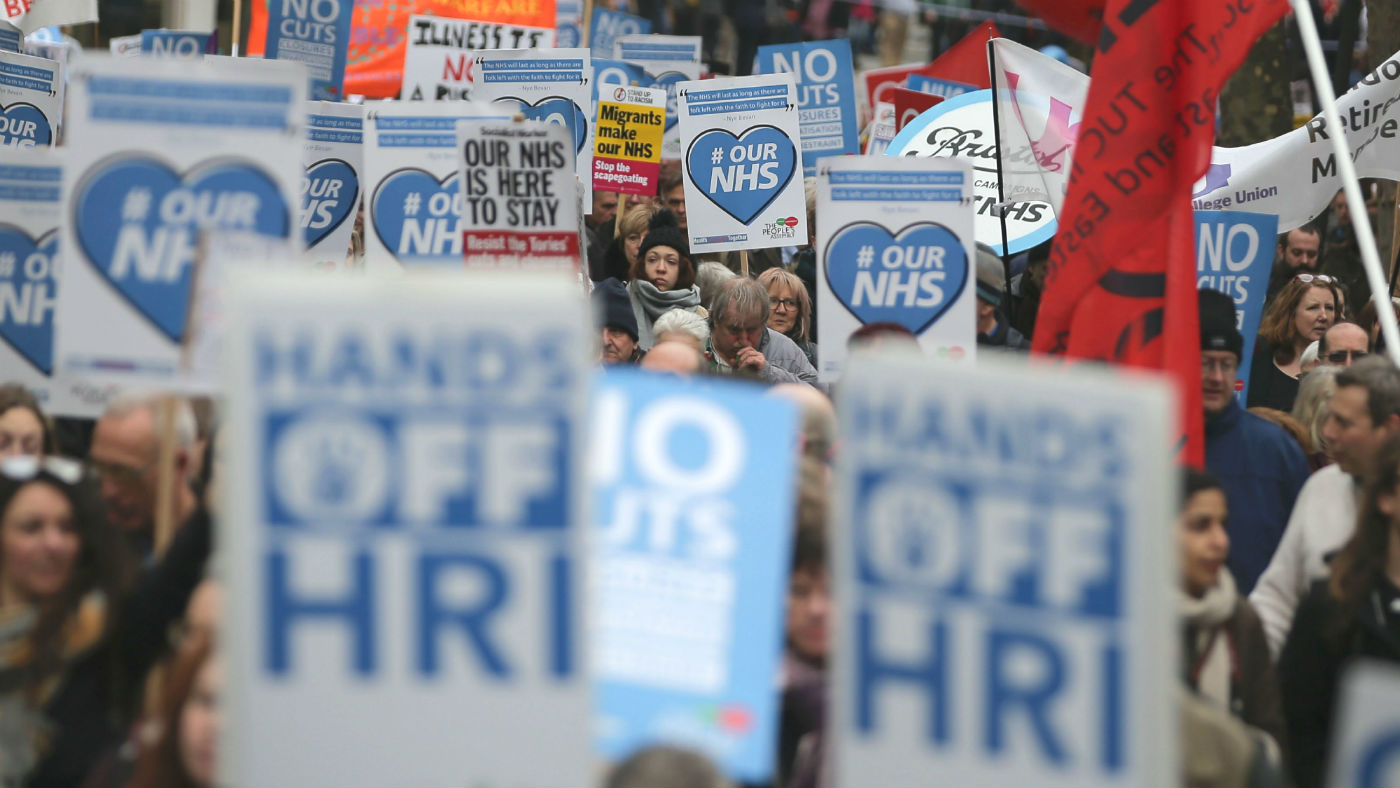
Despite Javid’s denials, anti-privatisation campaigners have
continued to warn against the bill, claiming it could entrench the
role of private sector firms in
the health service[3].
Will private firms ‘contol the
purse strings’?
The proposals include the establishment of 42 independently run
Integrated Care Systems (ICSs) that will cover the whole of the
country, “controlling purse strings and setting five-year plans”,
explained The Mirror[4]. Each ICS will oversee
the local NHS across areas containing one to two million
people.
These will remove “traditional divisions between hospitals and
family doctors, between physical and mental health, and between NHS
and council services”, said NHS England[5] – divisions that have
meant “too many people experienced disjointed care” in the
past.
Anti-privatisation campaigners have expressed concern over the
make-up of these ICSs, which will include representation from
councils, charities, trusts and local authorities, as well as
Integrated Care Boards (ICBs). These ICBs will be “accountable
for NHS spend and performance within the system” and will have the
power to decide on the type of healthcare that groups in their
local area will receive, according to the
government[6].
Sajid Javid has ‘absolute power’
Anger has been sparked by the decision to allow these powerful
ICBs to include representatives of private health firms, as well as
NHS clinicians and council public health leaders. Under Javid’s
plan, said The Mirror, private sector appointees to ICBs will be
blocked only if they “could reasonably be regarded as undermining
the independence of the health service”.
What’s more, the health secretary has “seized power to overrule
the independence of any ICS”, said Polly Toynbee in The Guardian.
This means Javid can “upend their decisions on mergers or
appointments according to political whim or cronyism”. He also has
“absolute power” over the appointments of all directors to the
ICBs.

In the Commons this week, Labour tried to block the bill from
allowing any private healthcare representatives (except for
GPs) on these influential health-commissioning boards.
“In Bath, in Somerset, we have seen Virgin Care get a seat on
the shadow ICS,” said shadow health secretary Jon Ashworth,
describing the situation as “unacceptable”.
His party colleague Richard Burgon and Cat Hobbs, the founder of
public ownership campaigning organisation We Own It, were quoted in
The Mirror as saying that the bill “entrenches an even greater role
for private companies in our NHS, one where private companies not
only profit from people’s ill health but increasingly get to decide
who gets what treatments and when”.
More contracts for cronies?
Another major criticism of the bill by anti-privatisation
campaigners is a change to the procurement rules that govern how
the NHS locally buys care for people.
The proposal is designed to cut red tape and save time and
money, said The Mirror, but the British Medical Association has
warned that the rules “allow contracts to be awarded to private
providers without proper scrutiny or transparency”.
Under the new bill, there is “every possibility” that private
companies “will have the opportunity to extend their contracts or
even be awarded new contracts without competition”, wrote Sian
Norris in Byline Times[7].
The government is already facing “accusations of cronyism after
it emerged that some firms were given access to a High Priority
Lane which fast-tracked their bids for personal protective
equipment (PPE) contracts”, said The
Independent[8].
But not just private providers at the
table
However, major voices in the health industry have disagreed that
the inclusion of private sector appointees to ICBs and changes to
NHS procurement rules are steps towards privatising England’s
health service.
The Nuffield
Trust’s[9] Brexit programme
lead Mark Dayan and senior fellow Helen Buckingham said they did
not see a widespread “corporate takeover” of the NHS as a likely
effect of the bill.
“There is nothing in the bill that would change the NHS from
being a publicly funded service, free at the point of use except
for existing charges for services like dentistry,” they wrote.
Dayan and Buckingham added that the NHS has paid private
providers to deliver free care since it was founded in 1948 and
that money has gone to private “secondary care” services since the
early noughties.
Referring specifically to the inclusion of private providers on
ICBs, Dayan and Buckingham noted that “NHS leaders, GPs, council
leaders and independent non-executives will also be at the table”.
Unlike private firms, they wrote, the bill insists that all boards
must include them, while meetings will be held in public and
“decisions must be transparent”.
“Why is it any more likely that a representative of a private
provider will succeed in getting more money, rather than the
representatives of NHS trusts or GPs?” they added.
Similarly, health minister Edward Argar has argued that “no one
will be appointed to an ICB who would undermine the independence of
the NHS”, The Mirror[10] added.
The bill is now heading to the House of Lords, where several
influential Conservative peers have said they will attempt to amend
the government’s blueprint for how health and social care will work
going forward, before sending it back to the Commons.
References
- ^
The
Guardian (www.theguardian.com) - ^
Sharon Graham
(www.theweek.co.uk) - ^
private sector firms in the health
service (www.theweek.co.uk) - ^
The
Mirror (www.mirror.co.uk) - ^
NHS
England (www.england.nhs.uk) - ^
according to the government
(www.gov.uk) - ^
Byline Times
(bylinetimes.com) - ^
The
Independent (www.independent.co.uk) - ^
Nuffield Trust’s
(www.nuffieldtrust.org.uk) - ^
The Mirror
(www.mirror.co.uk)
Get A Domain Name And Hosting On Dotifi.com.uk Today Click Link to get 10percent Off ! https://dotifi.co.uk/news/science-health/954924/will-the-health-and-care-act-really-privatise-the-nhs
Spread the love & Comment on Social Media !